Cooking Systems

Luxury Oven, Range, and Cooktop Repair in NYC

Detailed troubleshooting for pro-style cooking appliances in Manhattan residences, condo kitchens, and high-end homes. We repair Viking, Wolf, and Thermador as well as Samsung, LG, GE, KitchenAid, and Maytag ovens and ranges.

Frequent Cooking Appliance Faults

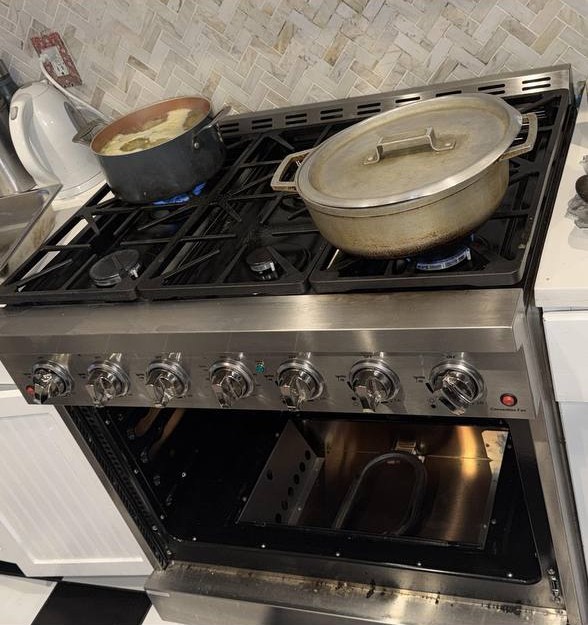
Professional six-burner gas range in a luxury NYC kitchen serviced by NYC Sub-Zero & Viking Appliance Repair
  • Gas ignition failure and delayed burner lighting.
  • Uneven baking or broiler underperformance.
  • Control panel errors, clock resets, and board faults.
  • Temperature overshoot/undershoot in convection modes.
  • Door hinge and gasket issues impacting heat retention.

Symptom Pattern Guide

Observed Issue Diagnostic Priority
Burner clicks but does not ignite Igniter, spark module, cap alignment, gas path integrity
Oven not reaching set temperature Sensor resistance, bake element, relay/control response
Display dead or intermittent Power feed, fuse, harness continuity, control board
Convection fan noise or no circulation Fan motor wear, obstruction, or control drive signal

Viking Professional 7 Series and 5 Series Range Troubleshooting

Viking Professional ranges have earned their place in high-end NYC kitchens by delivering commercial-grade BTU output and heavy-duty stainless steel construction. The 7 Series, Viking's flagship, features ViChrome griddle surfaces, a TruGlide full-extension oven rack system, and sealed brass burners capable of producing up to 23,000 BTU on the front burners. However, these powerful burners require precise gas-air mixture calibration, and the brass burner heads are susceptible to carbon buildup from high-volume cooking. When a Viking 7 Series burner produces uneven flame patterns, yellow tips, or delayed ignition, our technicians disassemble the burner assembly and thoroughly clean the ports, venturi tubes, and spark electrode gap. We also inspect the flash tubes that allow crossover ignition between adjacent burners, since a blocked flash tube can prevent an entire row of burners from lighting.

The Viking 5 Series range provides many of the same professional features at a slightly lower price point, with sealed burners rated up to 18,500 BTU and a smaller oven cavity. Common service issues on the 5 Series include burner igniter cracking due to thermal stress, gas valve solenoid failure that prevents gas flow to one or more burners, and control knob stem seal leaks that can allow small amounts of gas to seep when the burner is in the off position. Our technicians replace Viking igniters with genuine OEM components that match the specific amperage draw required to open the safety valve, and we perform gas leak testing with an electronic combustible gas detector at every connection point after any gas-related repair.

Wolf Dual-Fuel and Gas Range Diagnostics

Wolf ranges represent the pinnacle of residential cooking engineering, and their dual-fuel models combine the responsiveness of gas burners with the precision of electric convection ovens. The Wolf DF series features dual-stacked burners with an innovative design that provides both high-power searing output and a low simmer setting as gentle as 300 BTU, achieved through a secondary ring of smaller ports beneath the primary burner cap. When the low simmer function stops working while the high output remains normal, the issue typically lies in the secondary gas orifice becoming clogged with cooking residue or in the dual solenoid gas valve failing to open the low-flow circuit. Our technicians disassemble the burner stack, ultrasonically clean the precision orifices, and test the solenoid valve electrically to confirm proper dual-stage operation.

The electric oven section of a Wolf dual-fuel range uses true European convection with a rear-mounted fan and a dedicated heating element that surrounds the fan blade. This arrangement circulates heated air uniformly throughout the cavity, eliminating hot spots that plague conventional radiant bake elements. When the convection system underperforms, we evaluate the convection fan motor for bearing wear, the convection element for continuity and proper resistance, and the relay on the main control board that energizes the convection circuit. Wolf also incorporates a temperature probe port in many models, and a malfunctioning probe jack can cause the oven to display inaccurate internal temperatures, which we verify using a NIST-traceable oven thermometer during calibration.

Thermador Pro Grand and Pro Harmony Range Service

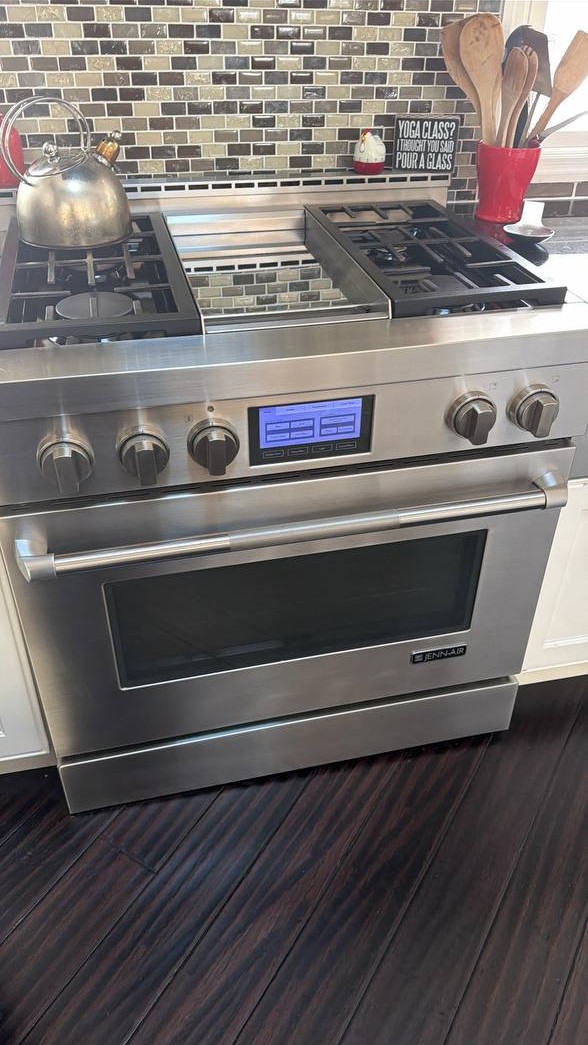
Jenn-Air professional range with griddle and touchscreen display in a New York City kitchen

Thermador's Pro Grand range, available in 48-inch and 60-inch configurations, is a centerpiece appliance in many luxury Manhattan and Westchester kitchens. The Pro Grand features Thermador's patented Star Burner design, which delivers a wider, more even flame spread than traditional round burners by distributing gas through a five-pointed star pattern with 56 individual ports. This design provides excellent coverage on large cookware but also means that partial port blockages, even a few clogged holes, can create noticeable cold spots in the flame pattern. Our technicians use precision cleaning pins sized specifically for the Star Burner port diameter and inspect the igniter electrode positioning to ensure reliable spark generation across the entire star surface.

The Thermador Pro Harmony range offers similar Star Burner technology in a more compact configuration, often chosen for NYC apartments where kitchen space is limited. Both the Pro Grand and Pro Harmony models feature Thermador's ExtraLow simmer capability and a steam-assist oven function on select models. Common service calls involve the steam generator calcifying from hard NYC water, the oven door lock actuator binding during self-clean cycle initiation, and the electronic control board losing communication with the cooktop module. Our technicians descale the steam system, rebuild or replace door lock assemblies with OEM actuators, and reprogram control boards when communication errors are stored in the diagnostic memory.

Gas Ignition System Repair: Igniters, Gas Valves, and Manifold Pressure

The gas ignition system on a professional-style range is more complex than on a standard residential unit because it must handle higher gas volumes, multiple burner zones, and often a combination of oven and cooktop circuits fed from a single manifold. The igniter is the most frequently replaced component in this system. Hot surface igniters, used in most oven burners, are ceramic silicon carbide or silicon nitride elements that must reach a specific minimum amperage draw, typically 3.2 to 3.6 amps depending on the brand, to open the oven safety valve and allow gas flow. When an igniter weakens with age, it may still glow visibly but fail to draw enough current to open the valve, resulting in an oven that glows but never lights. We measure igniter amperage under load to determine whether replacement is needed, rather than relying solely on visual inspection.

Gas valve solenoids control the flow of gas to individual burners and oven circuits. Each solenoid is an electromagnetic coil that lifts a plunger to open a gas port when energized by the control system. Over thousands of heating cycles, the solenoid coil windings can develop open circuits or short circuits, and the plunger seat can wear, causing a slow gas leak even when the valve is supposed to be closed. Our technicians test each solenoid coil with a milliamp clamp meter while the burner is commanded on, verifying that the coil draws the correct current and the valve opens fully. For Viking and Wolf ranges with dual solenoid valves that control both high and low flame positions, we test each solenoid independently to isolate which stage has failed.

Manifold gas pressure must be within the manufacturer's specified range for safe and efficient operation. For natural gas, most luxury ranges require a manifold pressure between 3.5 and 4.0 inches of water column, while propane conversions require approximately 10 inches. Incorrect manifold pressure can cause yellow flames, sooting, carbon monoxide production, or burners that will not stay lit. Our technicians connect a manometer to the manifold pressure test port during every gas ignition repair to verify proper pressure, and we adjust the pressure regulator if necessary. This step is particularly important in NYC buildings where the gas supply pressure from the street can vary depending on the time of day, the number of units drawing gas simultaneously, and the age of the building's gas piping infrastructure.

Oven Temperature Calibration, Convection Fan Motors, and Self-Cleaning Door Lock Repair

Oven temperature calibration is a service that many homeowners do not realize is available, yet it can dramatically improve baking and roasting results. Luxury oven control boards allow the temperature offset to be adjusted in small increments, typically five degrees at a time, to compensate for sensor drift or installation variables that cause the actual cavity temperature to differ from the display reading. Our technicians place a calibrated oven thermometer at the center of the rack, run the oven through a complete preheat and stabilization cycle, and compare the measured temperature to the displayed setpoint. If the variance exceeds ten degrees, we adjust the calibration offset through the control board's service mode. For Wolf and Viking ovens, this calibration procedure is accessible through specific button combinations that are documented in the service manual but not in the owner's guide.

Convection fan motor replacement is a common repair on heavily used luxury ovens. The fan motor bearing operates in an extreme thermal environment, and over years of service the bearing grease breaks down, causing the motor to become noisy, develop a wobble, or fail to spin entirely. When a convection fan motor fails, the oven may still heat using the bake and broil elements, but cooking results will be uneven and preheat times will increase substantially. We carry OEM fan motor assemblies for Viking, Wolf, Thermador, and Miele ovens, allowing us to complete this repair during a single visit in most cases.

The self-cleaning cycle in a premium oven heats the cavity to approximately 900 degrees Fahrenheit to incinerate food residue. Before the cycle begins, a motorized door lock actuator engages a mechanical latch that prevents the door from being opened during the high-temperature phase. When this actuator fails, the oven may refuse to start the self-clean cycle, or worse, the door may lock and not release after the cycle completes. Our technicians access the latch assembly behind the oven's front panel, test the actuator motor and the position switch, and replace the complete latch mechanism if any component shows wear. We also inspect the door gasket for heat damage after every self-clean service, since the extreme temperatures can accelerate gasket deterioration.
Electronic Control Board Repair, Cooktop-Specific Issues, and NYC Gas Code Compliance

Modern luxury ranges and cooktops rely on sophisticated electronic control boards that manage ignition timing, temperature regulation, display interfaces, and safety shutoff functions. Touchscreen ranges from Dacor, Miele, and some Thermador models use capacitive touch panels laminated to a glass surface. These panels can become unresponsive when internal flex cable connections loosen due to thermal expansion and contraction, or when moisture infiltrates the panel assembly from steam generated during cooking. Our technicians troubleshoot control panel issues by first verifying the ribbon cable connections at the board, testing the power supply voltages feeding the display module, and performing a factory reset sequence before recommending a full panel replacement.

Cooktop-specific repairs include induction burner failures on models from Thermador, Miele, and Gaggenau. Induction cooktops generate heat through electromagnetic fields created by copper coils beneath the glass surface. When an induction zone fails to heat, the cause may be a blown IGBT transistor on the power board, a failed resonant capacitor, a cracked ferrite core, or a surface sensor that does not detect compatible cookware. Our technicians use an oscilloscope to evaluate the high-frequency waveform generated by the induction driver circuit, isolating the failed component with precision. Electric cooktop elements, whether radiant ribbon or halogen, are more straightforward but still require proper matching of the element wattage and voltage to the control board relay capacity.

All gas range repairs performed by NYC Sub-Zero & Viking Appliance Repair comply with New York City building codes and fire department regulations. NYC requires that gas appliance work be performed by personnel trained in gas safety, and that any modification to gas connections be leak-tested and documented. Our technicians apply thread sealant rated for natural gas on all threaded connections, perform a soap-bubble test and electronic gas detection scan on every joint, and verify that the gas shutoff valve is accessible and operational as required by NYC code. For new installations or range conversions from electric to gas, we coordinate with licensed plumbers when gas line modifications are needed, ensuring full code compliance for our Manhattan and outer-borough clients.

Comprehensive Range and Oven Diagnostic Reference Table

Problem Description Probable Causes Diagnostic Method Standard Repair
Gas oven glows but will not ignite Weak igniter drawing insufficient amperage to open safety valve Measure igniter current with clamp ammeter while installed; compare to valve opening threshold Replace hot surface igniter with OEM unit matching the required amperage specification
Cooktop burner lights then goes out Thermocouple not heating sufficiently, loose thermocouple connection, or flame too low to reach sensor Measure thermocouple millivolt output; inspect flame contact with sensor tip Replace thermocouple, clean burner ports, adjust primary air shutter
Oven temperature runs 25+ degrees too hot or cold Temperature sensor resistance drift, calibration offset, or control board relay sticking Measure sensor resistance at room temperature (typically 1080-1100 ohms for most brands); verify calibration offset setting Replace temperature sensor, recalibrate oven offset, or replace control board
Self-clean door locked, will not open Door lock actuator motor burned out, position switch failed, or control board not sending unlock signal Check for voltage at actuator motor terminals during unlock command; test position switch continuity Replace door lock and latch assembly with OEM mechanism
Induction burner shows error code but no heat Incompatible cookware, cracked glass sensor, power board IGBT failure, or overtemperature protection tripped Test with known-compatible pan; inspect glass surface; measure IGBT gate signals with oscilloscope Replace power board, surface sensor, or allow thermal reset if overtemp protection activated
Uneven baking results in convection mode Convection fan motor bearing failure causing reduced airflow, blocked circulation path, or element not heating Listen for fan motor noise, measure fan RPM if accessible, check convection element continuity Replace convection fan motor assembly and/or convection heating element

Frequently Asked Questions: Oven and Range Repair in NYC

Is it safe to use my gas range if I smell gas near one burner?

If you detect a gas odor near your range, turn off all burners immediately and do not attempt to relight them. Open windows to ventilate the kitchen and avoid operating any electrical switches. If the smell is faint and localized to one burner area, it may indicate a minor valve seat leak or a loose connection. If the smell is strong or pervasive, leave the apartment and call your gas utility's emergency line. Once the situation is safe, contact our team at +1 (516) 973-0530 to schedule a professional gas leak inspection and repair. We test every gas connection with electronic detection equipment to ensure the issue is fully resolved.

Why does my Wolf range burner only work on high but not on low simmer?

Wolf dual-stacked burners use two separate gas circuits: one for the high-output primary ring and another for the low simmer secondary ports. If the low simmer function fails while the main burner works normally, the most common cause is a clogged secondary orifice or a failed low-flow solenoid in the gas valve. Cooking oil and food particles can block the small secondary ports over time. Our technicians clean these precision orifices with calibrated tools and test the dual solenoid valve to confirm both stages operate correctly, restoring the full range of flame control.

How do I recalibrate the oven temperature on my Thermador Pro Grand?

Thermador Pro Grand ovens have a calibration offset accessible through the control panel's service mode. While you can adjust this setting yourself using the instructions in the owner's manual, we recommend having a professional verification done with a calibrated oven thermometer placed at the rack center. Our technicians measure the actual cavity temperature over a full stabilization cycle and set the offset precisely, accounting for factors like door seal condition and oven sensor accuracy that a simple display adjustment cannot address.

Do you handle gas range repairs that comply with NYC building codes?

We perform gas range repairs and reconnections in full compliance with New York City building codes and fire department regulations. All gas connections are leak-tested using both soap-bubble and electronic combustible gas detection methods. We use gas-rated thread sealant on all connections and verify that the gas shutoff valve is accessible per code requirements. For new gas line work or modifications that require a permit, we coordinate with licensed NYC plumbers to ensure the complete installation meets all regulatory standards.

What should I do if my oven door will not unlock after a self-cleaning cycle?

If the oven door remains locked after the self-clean cycle has completed and the oven has cooled to a safe temperature, the door lock actuator motor or position switch may have failed. Do not attempt to force the door open, as this can damage the latch mechanism and the door hinges. First, try disconnecting the oven from power for five minutes to reset the control board, then reconnect and wait for the door unlock sequence to initiate. If the door still does not unlock, call our team to schedule a repair. We carry OEM door lock assemblies for Viking, Wolf, Thermador, and Miele ovens and can typically resolve this during a single appointment.

Client Testimonial: Professional Range Repair in Manhattan

"Our Thermador Pro Grand 48-inch range had a persistent issue where two of the six Star Burners would not ignite reliably. We went through two other repair companies who replaced igniters without solving the problem. NYC Sub-Zero & Viking's technician discovered that the flash tubes between the burners were partially blocked with grease residue, and the manifold pressure was running slightly low due to a regulator issue specific to our building's gas supply. After cleaning the flash tubes and adjusting the regulator, every burner now ignites instantly on the first spark. Their understanding of these professional-grade ranges is clearly a level above the competition."

-- David and Laura S., Tribeca, Manhattan

Customer Reviews

★★★★★

"Viking 6-burner range had two ignitors that wouldn't spark. Technician replaced both plus cleaned all burner caps. Cooks like the day we bought it."

Michael S. — Tribeca, Manhattan

★★★★★

"Wolf dual-fuel range was 25 degrees off on oven temp. Calibration and a new temperature sensor solved it. The tech really knew Wolf appliances inside out."

Jessica L. — Cobble Hill, Brooklyn

★★★★★

"Our GE Profile double oven wouldn't heat past 300 degrees. Bad bake element in the lower oven. Replaced same day, both ovens working perfectly now."

Thomas R. — Rego Park, Queens

Request Expert Oven and Range Repair Service in NYC

From Viking Professional burner cleaning to Wolf dual-fuel oven diagnostics and Thermador Star Burner ignition repair, our factory-trained technicians deliver precise, code-compliant service for every luxury cooking appliance. We carry genuine OEM parts and offer same-day appointments throughout Manhattan, Brooklyn, Queens, and the surrounding NYC metro area.