Laundry Systems

Luxury Washer and Dryer Repair in NYC

Specialized work for premium laundry appliances in high-rise units, townhouses, and custom laundry rooms. We service Miele and Bosch as well as Samsung, LG, Whirlpool, Maytag, GE, and Electrolux washers and dryers.

Washer and Dryer Issues

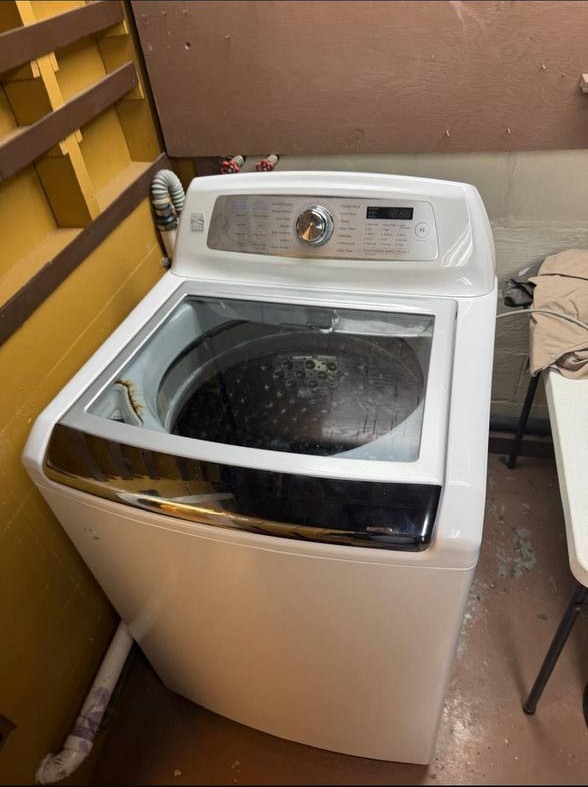
Top-load washing machine repair service by NYC Sub-Zero & Viking Appliance Repair in New York City
  • Washer not draining, not spinning, or vibration events.
  • Dryer not heating, slow dry cycles, moisture sensor errors.
  • Door lock, latch, or seal-related interruptions.
  • Stacked-unit communication and control board faults.
  • Leak and pump performance issues.

Miele W1 and T1 Series Washer and Dryer Diagnostics

The Miele W1 washer and T1 dryer series represent the pinnacle of European laundry engineering, offering features that are specifically well-suited to the demands of NYC apartment living. The W1 washer features Miele's TwinDos automatic detergent dispensing system, which stores two liquid detergent cartridges and meters the precise amount of detergent and fabric softener based on load size and soil level. When the TwinDos system malfunctions, common symptoms include excessive detergent usage, no detergent being dispensed at all, or the control panel displaying an error related to the cartridge recognition sensor. Our technicians evaluate the TwinDos pump, the cartridge dock connectors, and the dispensing channel for crystallized detergent blockages that prevent proper flow.

The Miele T1 dryer series includes both vented and ventless heat pump models, with the heat pump variants being especially popular in NYC apartments where exterior venting is not possible or is restricted by building regulations. The T1 heat pump dryer uses a closed-loop refrigerant system to condense moisture from the laundry, depositing the water into a collection reservoir or routing it to a drain connection. When the heat pump system underperforms, drying times increase dramatically, and clothes emerge damp even after extended cycles. Our technicians check the heat exchanger fins for lint accumulation, the refrigerant charge for leaks, the condenser fan motor for proper airflow, and the moisture sensor contacts for corrosion that can cause inaccurate readings. Miele T1 dryers also feature the FragranceDos system, and when this module fails, it can trigger nuisance error codes that interrupt cycle operation even though the core drying function is unaffected.

Bosch 500, 800, and Benchmark Series Compact Laundry Repair

Bosch compact laundry systems are the most widely installed premium washer-dryer pairs in NYC apartments due to their 24-inch width, stackable design, and remarkably quiet operation. The Bosch 500 Series provides solid baseline performance with a 2.2 cubic foot washer drum and a condensation dryer that eliminates the need for external venting. The 800 Series adds Home Connect Wi-Fi capability, a larger drum, and enhanced spin speeds that extract more moisture before the drying cycle begins. The Benchmark series offers the most advanced features, including an interior drum light, a steam refresh option, and the quietest motor in the Bosch lineup. Common issues across all Bosch compact laundry series include the door boot seal developing tears or mold along the inner folds, the drain pump filter clogging with coins, hair ties, and other small items left in pockets, and the electronic control module losing stored cycle settings after a power interruption.

The Bosch condensation dryer, standard in all NYC-appropriate models, works by passing warm air through the tumbling laundry, collecting the resulting moisture-laden air, and routing it through a condenser where the moisture is extracted and collected in a reservoir. The condenser unit requires periodic cleaning to maintain efficiency, and in dusty NYC apartments, lint can bypass the primary lint filter and accumulate on the condenser surfaces, reducing airflow and extending drying times significantly. Our technicians remove and clean the condenser assembly, inspect the blower motor for lint buildup, and test the NTC temperature sensor that regulates the air temperature inside the drum. On Bosch dryers with a condensate pump that routes water to the sink drain rather than a collection reservoir, we verify the pump operation and the drain line patency to prevent overflow events in the unit's base pan.

Stacked Unit Challenges in NYC Apartments: Vibration, Drainage, and Venting

Stacking a washer and dryer is standard practice in most NYC apartments where floor space is limited, but the stacked configuration introduces mechanical and installation challenges that do not exist with side-by-side placements. The primary concern is vibration during the wash cycle's high-speed spin phase. When a washer is stacked, any imbalance in the drum load is transmitted through the stacking kit to the dryer above and then to the floor and wall structure. In older NYC buildings with wooden floor joists, this vibration can resonate through the building and disturb neighboring units. Our technicians evaluate the stacking kit connections, verify that the washer is perfectly level using a precision spirit level, inspect the shock absorbers and suspension springs for wear, and confirm that the shipping bolts were properly removed during initial installation, a surprisingly common oversight that causes severe vibration.

Drainage in NYC apartment laundry installations varies widely depending on the building's plumbing infrastructure. Some units drain into a floor drain, others into a standpipe, and some connect to a condensate pump that lifts water to a sink drain or a higher plumbing connection. Each configuration requires specific hose routing, loop heights, and air-break provisions to prevent siphoning and backflow. When a washer fails to drain completely, or when water backs up into the tub after the cycle ends, the cause is often an improper drain configuration rather than a washer component failure. Our technicians evaluate the complete drain path, adjust the standpipe height and hose loop position, and install or replace condensate pumps when the gravity drain option is not available.

Venting for dryers in NYC apartments is regulated by building management and local codes. Many buildings prohibit exterior dryer venting due to facade restrictions, forcing residents to use ventless condensation or heat pump dryers. When a vented dryer is installed in a building that does not support external venting, lint and moisture are expelled into the apartment, creating indoor air quality issues and potential moisture damage. Our technicians advise NYC clients on the appropriate dryer type for their building's venting situation and can convert or replace vented dryers with ventless Miele or Bosch condensation models that require only a drain connection and an electrical outlet.

Washer Repair: Door Boot Seal, Shock Absorbers, Bearings, and Drum Spider

The door boot seal, also called the bellows or gasket, is the large rubber membrane that creates a watertight seal between the front-loading washer's tub and the door opening. This component endures constant flexing, exposure to detergent chemicals, and contact with hot water, making it one of the most common failure points on premium front-load washers. Tears in the boot seal allow water to leak onto the floor during the wash and rinse cycles, while mold growth in the boot's interior folds creates unpleasant odors that transfer to the laundry. On Miele W1 washers, the boot seal is secured by a wire spring clamp at both the tub and the door frame, and replacement requires careful disassembly of the front panel and precise repositioning of the drain hole at the bottom of the boot. Our technicians replace door boot seals with genuine OEM components and advise homeowners on maintenance practices, including leaving the door ajar between cycles and wiping the boot folds dry, to extend the life of the new seal.

Shock absorbers in front-load washers dampen the drum movement during the spin cycle, preventing the tub from banging against the cabinet walls. When the shock absorbers wear out, the washer produces loud banging noises during spin, the drum moves visibly and excessively, and the unit may walk across the floor if the vibration overcomes the anti-vibration pads. Replacing shock absorbers on a Bosch or Miele compact washer involves tilting the unit back or removing the front panel to access the mounting points. We always replace shock absorbers as a set to ensure balanced damping on both sides of the tub.

Bearing failure is a major repair that produces a distinctive rumbling or grinding noise during the spin cycle, often accompanied by water leaking from the rear of the machine as the bearing seal deteriorates. The drum spider, a three-armed aluminum or stainless steel bracket that connects the rear of the drum to the drive shaft, can also develop stress cracks or corrosion-induced fractures, particularly in units exposed to hard water or excessive detergent use. When the spider cracks, the drum becomes unbalanced and can wobble violently during spin. Our technicians assess whether bearing replacement alone is sufficient or whether the spider arm requires replacement as well, providing a cost-effective repair plan that avoids the expense of replacing the entire drum assembly unnecessarily.

Dryer Repair: Heating Elements, Thermal Fuses, Moisture Sensors, and Lint Management

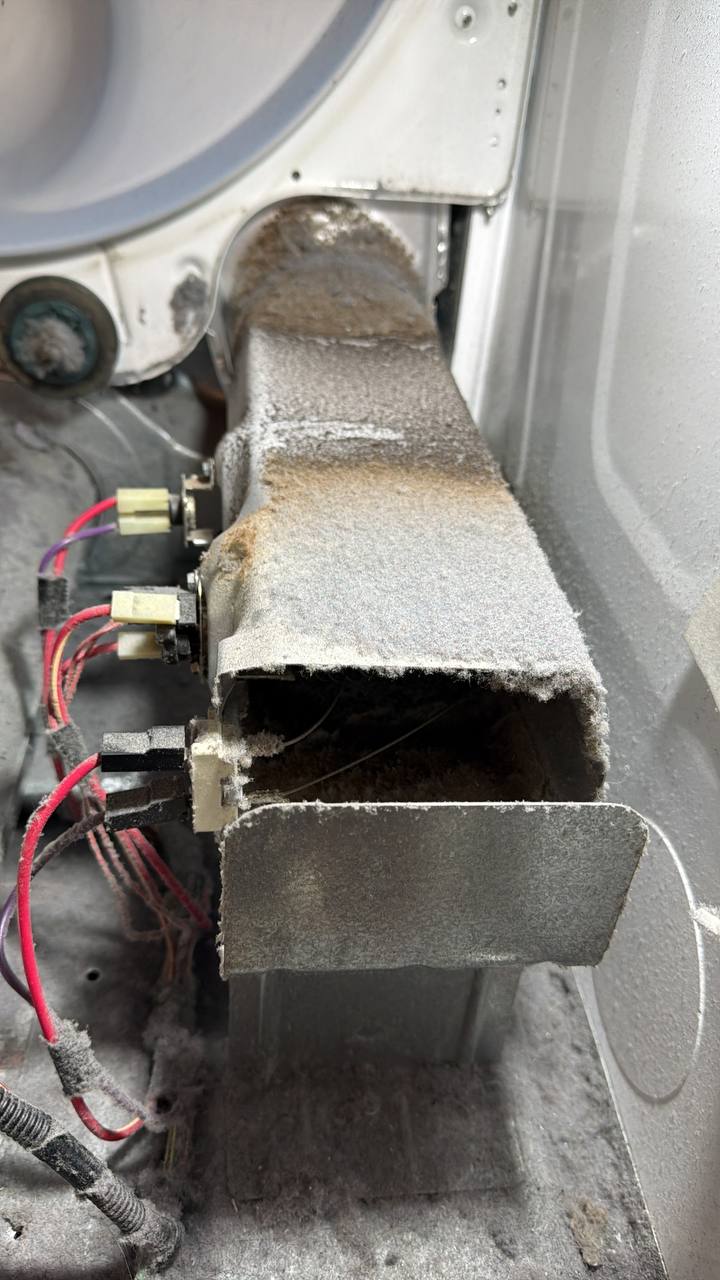
Heavily clogged dryer lint duct requiring professional cleaning and maintenance

When a dryer stops producing heat, the heating element is the first suspect, but it is not always the culprit. In electric dryers, the heating element is a coiled nichrome wire mounted in a housing that the drum air passes over. An open circuit in the element wire means no heat production, and this is confirmed with a simple continuity test. However, a tripped thermal fuse or a failed high-limit thermostat can produce identical symptoms. The thermal fuse is a one-time safety device that blows when the dryer exceeds its safe operating temperature, typically due to a lint-blocked exhaust path or a failed cycling thermostat. Our technicians test all three components, the element, the thermal fuse, and the high-limit thermostat, before replacing any part, and we always investigate the root cause of a blown thermal fuse to prevent the replacement from failing again.

Moisture sensors in premium dryers use two or more metal strips inside the drum that detect the conductivity of the tumbling laundry. Wet fabric conducts electricity between the strips, signaling the control board that the load is still damp. As the clothes dry, conductivity decreases, and the board eventually terminates the cycle. When these sensor strips become coated with fabric softener residue or mineral deposits from hard water, their sensitivity decreases, and the dryer may shut off prematurely, leaving clothes still damp. We clean the sensor strips with a fine abrasive pad and isopropyl alcohol, and we test the sensor circuit with a damp cloth to verify proper signal transmission to the control board.

Lint management is a critical safety and performance issue for dryers in NYC apartments. Beyond cleaning the primary lint screen after every load, the interior ductwork, the blower housing, and the exhaust hose accumulate lint over time. In ventless condensation dryers, lint can also build up on the condenser heat exchanger and the secondary lint filter that many users do not realize exists. Our technicians perform a comprehensive lint cleaning service that includes disassembling the dryer cabinet, vacuuming the blower channel, cleaning the condenser fins, and inspecting the exhaust hose for restrictions. For vented dryers, we also measure the exhaust airflow at the terminal with an anemometer to verify that the vent run meets the manufacturer's minimum CFM requirement.

Ventless Condenser Dryer Troubleshooting and Electronic Control Module Repair

Ventless condenser dryers are the preferred solution for NYC apartments that lack external dryer venting, but they require different maintenance and troubleshooting approaches compared to traditional vented dryers. The condenser assembly must be cleaned regularly because lint accumulation on the condenser surfaces blocks airflow and drastically reduces drying efficiency. On Bosch ventless dryers, the condenser is accessed through a door in the lower front panel. On Miele T1 heat pump dryers, a self-cleaning condenser feature uses condensed water to periodically flush lint from the condenser fins, but this system can fail if the spray nozzles become clogged or the water collection tank is not emptied when full. Our technicians service the condenser cleaning system, flush the spray nozzles, and verify the tank float switch operation to ensure the self-cleaning function works properly.

Electronic control module failures in washers and dryers can produce a wide range of symptoms, from complete non-operation to erratic cycle behavior, random error codes, and intermittent starts and stops. The control module is essentially a small computer that manages all motor functions, valve operations, sensor readings, and user interface inputs. Power surges from NYC grid fluctuations, lightning events, and building generator transfers are the leading causes of control board failure. Our technicians inspect the board for visible damage including burnt components, corroded traces, and swollen capacitors. When replacement is necessary, we source genuine OEM control modules and program them with the correct software version and configuration settings for the specific model, ensuring all cycle options and diagnostic functions operate as the factory intended.

Motor brush replacement is another repair specific to older Miele and Bosch washers that use universal motors with carbon brushes. As the brushes wear down, the motor loses power during the spin cycle, and the washer may fail to reach full spin speed, leaving clothes excessively wet. The worn brushes produce visible carbon dust inside the motor housing and can create sparking that triggers an error code on the control board. Our technicians measure the remaining brush length, and if it falls below the manufacturer's minimum specification, we replace both brushes as a pair and clean the commutator surface to ensure good electrical contact.

NYC Apartment Laundry: Compact 24-Inch Units and Condensate Pump Configurations

The 24-inch compact washer and dryer format is the standard for NYC apartment laundry installations, fitting into closets, bathrooms, and kitchen alcoves where full-size 27-inch units simply cannot be accommodated. Miele and Bosch are the dominant brands in this segment, and both offer stackable pairs that deliver excellent wash and dry performance within a footprint of approximately 24 inches wide by 24 inches deep. However, the compact format means that these machines have smaller drum capacities, typically 2.2 to 2.4 cubic feet for washers and 4.0 to 4.4 cubic feet for dryers, which limits load size and requires more cycles for larger households. Our technicians understand the operating parameters of compact laundry units and can advise on load management, cycle selection, and maintenance schedules that optimize performance within these constraints.

Condensate pump configurations are common in NYC laundry installations where the washer or dryer drain connection is positioned above the appliance's drain outlet. A condensate pump collects water from the appliance and lifts it to the elevated drain point, typically a sink drain or a standpipe. These pumps have a limited lifespan and can fail due to debris clogging the impeller, the float switch sticking, or the check valve allowing water to flow back into the pump basin. When a condensate pump fails, water either backs up into the appliance, causing an error code, or overflows the pump basin onto the floor. Our technicians carry replacement condensate pumps rated for laundry applications and can install them with proper routing and check valve protection during a single service visit.

Washer and Dryer Diagnostic Reference Table

Issue Common Causes Diagnostic Procedure Repair Solution
Washer vibrates excessively during spin Worn shock absorbers, shipping bolts still installed, unlevel machine, unbalanced load Check for shipping bolt presence, verify level with spirit level, inspect shock absorbers for fluid leakage Remove shipping bolts, relevel machine, replace shock absorbers as a set
Washer leaking from door area Torn door boot seal, clogged boot drain hole, door hinge misalignment, excess suds Inspect boot seal interior for tears, check drain hole patency, verify hinge alignment and door closure Replace door boot seal with OEM part, clear drain hole, adjust door hinge
Dryer runs but no heat Open heating element, blown thermal fuse, failed high-limit thermostat, tripped circuit breaker leg Test element continuity, check thermal fuse, verify thermostat, confirm both breaker legs are delivering voltage Replace failed component; investigate and resolve root cause of thermal fuse blow
Dryer takes excessively long to dry clothes Lint-blocked exhaust or condenser, worn moisture sensor contacts, failed condenser fan Measure exhaust airflow, clean condenser, test moisture sensor strip conductivity, verify fan RPM Clean lint path and condenser, restore moisture sensor contacts, replace fan motor if needed
Washer drum makes grinding noise during spin Worn tub bearings, cracked drum spider arm, foreign object between drum and tub Rotate drum by hand feeling for roughness, inspect spider arm through drum holes, check for trapped debris Replace bearings and seal, replace spider arm if cracked, remove foreign object
Washer will not drain Clogged drain pump filter, failed pump motor, kinked drain hose, improper standpipe height Access and clean pump filter, test pump motor electrically, inspect drain hose routing and standpipe dimensions Clear filter, replace pump motor, correct drain routing per manufacturer specifications

Frequently Asked Questions: Luxury Washer and Dryer Repair in NYC

Can you repair a Miele heat pump dryer in a NYC apartment without exterior venting?

Yes, Miele T1 heat pump dryers are designed specifically for installations without exterior venting, which makes them ideal for most NYC apartments. These dryers use a closed-loop refrigerant system to condense and collect moisture rather than exhausting it outside. When the heat pump system needs repair, our technicians evaluate the refrigerant circuit, the condenser heat exchanger, the evaporator coil, and the compressor to restore full drying performance. We also service the self-cleaning condenser mechanism that keeps the heat exchanger free of lint accumulation.

Why does my Bosch compact washer vibrate so much in my apartment?

Excessive vibration in a Bosch compact washer is most commonly caused by worn shock absorbers, an unlevel installation, or shipping bolts that were not removed during the initial setup. In NYC apartments with wooden subfloors, even a properly functioning washer can transmit vibration into the building structure. Our technicians verify the machine is level, inspect the shock absorbers for wear, confirm all shipping hardware has been removed, and can install anti-vibration pads designed to absorb the oscillation frequencies produced during high-speed spin cycles.

How often should I clean the condenser on my ventless dryer?

For Bosch ventless condenser dryers without self-cleaning, we recommend cleaning the condenser every 30 to 40 drying cycles, or approximately once per month for a typical NYC household. Miele T1 heat pump dryers with the self-cleaning condenser feature require less frequent manual cleaning, but we recommend a thorough professional service every 12 months to address lint that the self-cleaning system cannot fully remove. A clean condenser is essential for maintaining drying efficiency and preventing overheating that can trip the thermal protection system.

What causes black mold on my front-load washer door seal?

Black mold on the door boot seal of a front-load washer is caused by moisture that remains trapped in the rubber folds between wash cycles. The warm, damp environment inside the boot is an ideal breeding ground for mold and mildew. Contributing factors include using too much detergent, which leaves a residue film that mold feeds on, and keeping the door closed between cycles, which prevents air circulation. Our technicians clean the existing mold, assess whether the seal needs replacement, and recommend maintenance practices including running a monthly hot water cleaning cycle with a washing machine cleaner and leaving the door cracked open after every use.

Do you service stacked washer-dryer units in small NYC apartments?

We service stacked Miele, Bosch, and Thermador washer-dryer units in apartments throughout Manhattan, Brooklyn, Queens, and the surrounding boroughs. Our technicians are experienced with the access constraints of NYC apartment laundry closets and carry the tools needed to safely disassemble stacking kits, pull units forward in tight spaces, and perform repairs without damaging surrounding cabinetry or flooring. We can service both the washer and dryer in a stacked configuration during a single appointment.

Client Testimonial: Laundry Repair in a Manhattan Apartment

"Our Miele W1 washer and T1 dryer stack in our Murray Hill apartment had multiple issues: the washer was leaking from the door seal, and the dryer was taking over two hours to complete a normal cycle. NYC Sub-Zero & Viking's technician replaced the door boot seal with an OEM Miele part and discovered that the dryer's heat pump condenser was heavily blocked with lint that the self-cleaning system had not removed. After a thorough condenser cleaning and recalibration of the moisture sensors, both units are performing like new. Their expertise with Miele laundry systems and their understanding of apartment-specific installation challenges are exactly what NYC residents need."

-- Jennifer and Mark H., Murray Hill, Manhattan

Customer Reviews

★★★★★

"Samsung front-loader was shaking violently during spin cycle. Worn shock absorbers and a loose counterweight. Fixed on the spot, runs smooth and quiet now."

Daniel F. — Hell's Kitchen, Manhattan

★★★★★

"Whirlpool dryer wasn't producing heat. Technician found a blown thermal fuse and cleaned the entire vent line. Dryer heats up fast now and clothes dry in one cycle."

Rachel C. — Nassau County, NY

Schedule Luxury Washer and Dryer Repair in NYC

From Miele W1 and T1 series diagnostics to Bosch compact laundry troubleshooting, our factory-trained technicians provide expert washer and dryer repair throughout New York City. We specialize in the compact 24-inch units, ventless dryer systems, and stacked configurations that NYC apartment living demands. Same-day and next-day appointments available.